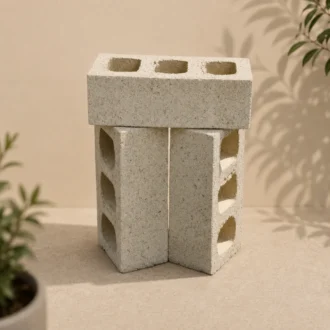
Ivory clay bricks provide a pale, elegant masonry finish with a warmer character than pure white. Products in this tag may contain subtle cream, sand or light-grey undertones. Compare the listed bricks for colour consistency, surface texture, dimensions and intended use before requesting samples or a delivered quotation.
Ivory is normally paler and quieter than cream, and less yellow than many buff ranges. Its restrained tone makes small changes in mortar, shadow and surrounding materials especially noticeable. A textured ivory brick creates gentle depth, whereas a smooth version produces a cleaner and more formal elevation.
Compare ivory samples against white paint to identify their true undertone. A colour-matched mortar gives a seamless pale wall, while grey mortar introduces a visible module. Because marks can stand out on very light masonry, specify careful storage, clean laying and only approved cleaning methods.
Ivory brickwork suits refined contemporary homes, understated estate architecture and interiors that need texture without a strong colour statement. It can cover a complete facade or lighten selected sections beside dark brick. The palette feels warmer when combined with timber and more graphic when outlined by black frames.
Useful material and colour pairings include:
Suitability depends on the classification of the individual product. Options listed under this colour tag may include:
A face brick is a walling product and should not automatically be used for paving. For patios, paths and driveways, select a purpose-manufactured clay paver suitable for the expected pedestrian or vehicle traffic.
Measure the net area in square metres. For walls, multiply total wall length by height and subtract doors, windows and other openings. For paving, multiply the length by the width of each section and add the sections together.
| Application | Estimating rate | Formula |
| Single-skin face-brick wall | 55 bricks per m² | Net wall area x 55 |
| Double-skin face-brick wall | 110 bricks per m² | Net wall area x 110 |
| Clay paving | 50 pavers per m² | Paving area x 50 |
Worked example for 12 m²: allow 660 face bricks for a single-skin wall, 1,320 face bricks for a double-skin wall, or 600 clay pavers for a paved area of the same size. Round quantities up and ask the supplier or builder what additional allowance is appropriate for cuts, breakages, bond pattern and site conditions. Use the full Brick Tile Shop brick calculator for a project estimate.
Brick Tile Shop helps customers source ivory clay bricks for projects across Gauteng, from Pretoria and Centurion to northern Johannesburg and the East Rand. Delivery beyond Gauteng may be quoted where stock, order quantity and transport conditions allow.
Ivory usually appears paler and closer to off-white; cream tends to be warmer or more biscuit-toned.
Some ranges do, but warm undertones and mortar colour become more evident in natural light and at closer range.
Ivory or cream mortar softens the joints. Light grey provides controlled definition without the strong contrast of dark mortar.
Yes, if the chosen face brick is suitable for the exposure and the wall is designed and built correctly.
No assumption should be made from appearance. Use only a purpose-classified ivory clay paver for patio construction.
Browse the ivory products shown in this archive and open the individual listings to compare size, classification, texture, price and stock status. For an accurate quotation, send Brick Tile Shop the product name, required quantity and delivery address. Request samples where colour matching is important.