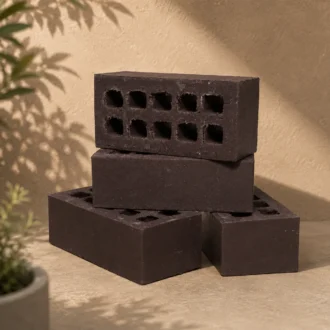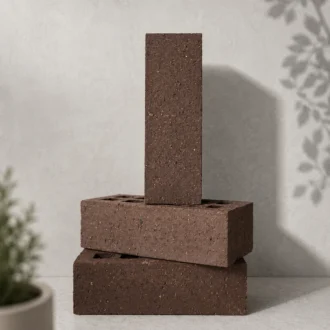
Charcoal brown clay bricks combine earthy brown warmth with charcoal, graphite or near-black shading. This product tag helps buyers compare dark face bricks and clay pavers with a grounded, contemporary character. Review each listed product for its exact dimensions, texture, classification, price and availability before ordering.
Unlike a plain brown brick, charcoal brown usually carries cooler fired-dark areas that add depth without creating a uniformly black wall. Smooth products can appear precise and modern, while rustic or multi-blend products create stronger movement across a facade. Check several bricks together because one sample cannot show the complete blend.
Compare whether the brick leans mainly brown or mainly charcoal, then view it beside the roof, windows and planned paving. A medium-grey joint gives balanced definition; a darker joint creates a quieter, more continuous surface. Build a sample panel and mix bricks from several packs during construction so the tonal variation is distributed naturally.
This colour works particularly well on modern lodges, industrial-inspired homes, boundary walls and commercial entrances. Use it across a complete elevation for visual weight, or as an accent around a recessed entrance, chimney or braai area. Timber prevents the palette from feeling cold, while pale plaster makes the dark masonry more prominent.
Useful material and colour pairings include:
Suitability depends on the classification of the individual product. Options listed under this colour tag may include:
A face brick is a walling product and should not automatically be used for paving. For patios, paths and driveways, select a purpose-manufactured clay paver suitable for the expected pedestrian or vehicle traffic.
Measure the net area in square metres. For walls, multiply total wall length by height and subtract doors, windows and other openings. For paving, multiply the length by the width of each section and add the sections together.
| Application | Estimating rate | Formula |
| Single-skin face-brick wall | 55 bricks per m² | Net wall area x 55 |
| Double-skin face-brick wall | 110 bricks per m² | Net wall area x 110 |
| Clay paving | 50 pavers per m² | Paving area x 50 |
Worked example for 18 m²: allow 990 face bricks for a single-skin wall, 1,980 face bricks for a double-skin wall, or 900 clay pavers for a paved area of the same size. Round quantities up and ask the supplier or builder what additional allowance is appropriate for cuts, breakages, bond pattern and site conditions. Use the full Brick Tile Shop brick calculator for a project estimate.
Brick Tile Shop assists projects across Pretoria, Centurion, Midrand, Johannesburg and the wider Gauteng region. Nationwide delivery may be arranged subject to the product, order volume, destination and site access. Send the product name, quantity and delivery suburb when requesting a quotation.
No. Charcoal brown retains visible coffee or earthy undertones, whereas black and graphite bricks usually read cooler and darker.
Medium-grey mortar outlines the units gently. Dark-grey mortar creates a more blended contemporary result. Test both in a sample panel.
Yes, when the selected product is classified for the intended exterior walling or paving exposure. Check the individual specification.
Not necessarily. Fired-clay blends can include brown, charcoal and black variation. Use bricks from multiple packs while laying.
Only if that exact product is manufactured and classified as a clay paver. A walling brick should not be assumed suitable for paving.
Browse the charcoal brown products shown in this archive and open the individual listings to compare size, classification, texture, price and stock status. For an accurate quotation, send Brick Tile Shop the product name, required quantity and delivery address. Request samples where colour matching is important.